Friday, April 4, 2014

How Easy is it to Write a Book?

Ohhh, that's a tough question. Or a many-answered question.

I was an ad writer for 30 years. It's good preparation. Many people think you have to be inspired to sit down to write. People introduce themselves as writers and tell me they only write when inspiration hits.

Maybe it works. Seems like the output would be sporadic at best.

Mystery writer, Aaron Elkins, says he gets inspired every morning at nine.

Ad writers don't get to be inspired. Somebody brings an assignment and the ad writer starts writing. Not "thinking" about it, but actually making words appear on the page. Before I'd completed a single novel I wrote millions of words.

Ecstasy of Writing

Ecstasy? Really? 

I think we've all seen movies about writers. When they finally overcome all the movie obstacles and sit down to write, the writer gets a sort of absurdly happy look on his or her face.  We know then that they are going to be discovered, successful, get the girl or the guy, and so forth. 

Here's the deal, or at least an important part of the deal. 

Writing, before anything else, is the physical act of filling pages with words. It's an enduro. 

The writer sits down, starts typing, keeps typing, may or may not like it on any given day, worries that it isn't any good and nobody will ever read it–much of the time feels horrible about the whole process–and so forth. 

Somewhat short of ecstasy. 

First Rule of Writing

Wait for it. Wait for it.

Just start writing. That's it. No matter how it goes, no matter how it feels. 

What if it's just no good? 

A lot of popular writing is just no good. But that's why you re-write. Darn few books are only written once. 

As my annoying younger brother, Joel, much too frequently says: "Do it. Do it now!" 

Questions? Write anytime. 
JonathanThomasStratman@gmail.com

Thursday, April 3, 2014

Dear Mr. Stratman, I Wonder How Long it Took for You to Make the Book?

Here's a letter from Kenny, also in Ms. Slater's class in Vermont. His question is another of those many people ask.

Dear Mr. Stratman,

Thank you for Cheechako.  It is a really good book!  We hope that there are more than 2 books in the set .

I think the best part is when Will goes out in a blizzard to save his family and friend. 

I wonder how long it took for you to make the book? 

I like the way you write about what happens to you in your childhood. My friend Wyatt and I read ahead about 80 pages and finished the book.  We like the book a lot but book 2 is probably even better than the 1st one.

I can't wait to read book 2!

Sincerely,
Kenny  


Dear Kenny,

As you can probably guess, there are about a million answers to that question.

I know writers who challenge themselves to write a page a day. I know others who might write 30 pages at a burst. That kind of writer usually doesn't write that often, just walks around with his/her ideas until he has the time to write, or it just explodes out of him.

"Cheechako," my first published book–and, at 140 pages, my shortest book–took me about 30 years to write. Not a typo: 30 years.

I wrote a version of chapter one and it was published as a short story in Cricket Magazine in the early '80s. In those days, they paid about 25 cents a word and I think I remember making about $400 on it.

One of the Cricket editors wrote to me and said, "this should be a book." I knew she was right but it takes more than knowing to get through to that last page. Several other chapters were also published as short stories by Cricket.

Writing a Book is Like Reading a Book Really Slowly.

Ray Bradbury once told me that he wrote one sentence and then tried to figure out another sentence to follow it. I've done that, times when I was a little bit stuck.

Mostly what I do is just ask myself "what comes next?" Another way of saying that is, "what can happen next that will make Scott, Kenny, Wyatt, and others like them, in classrooms in Vermont and around the world, keep turning those pages and keep being excited to find out what happens?"

Usually I have a few scenes that I've imagined in advance. For example, in one of my mystery stories, I knew before I started writing the book, that the hero and his girlfriend would be tied to anchors and be tossed off the deck of an old sailing ship. 

Did I have a way to save them? Well, sure. Otherwise it would be a very short book. 

Since I knew I had to first get them to the ship, I sort of knew what to write next. 

Researching "Cheechako," I found out about a rare-ish black wolf that lives near Denali National Park, about 60 miles south of Nenana, the town where Will, Elias and Blackie live. So I started writing in the direction of those wolves. And Kenny, you already know how that turned out. 

Finally, you mentioned Book 2 in the Cheechako Series, which is called "Float Monkeys." It's already out for e-books and in paperback, and well reviewed. Be sure to write and ask any questions you have about that. 

Thanks for a really good question and for reading and liking "Cheechako." 

Best regards,   Jonathan 

JonathanThomasStratman@gmail.com


Wednesday, April 2, 2014

Dear Mr. Stratman, Why Did You Become An Author?

Recently I received a letter from Scott, who had just finished reading "Cheechako," in Ms. Slater's Jr. High class in Vermont. Since it's a question I often get from readers, I thought I would also answer it here in the blog. Feel free to write with questions of your own.


Dear Mr. Stratman,

I loved your book.  My favorite part of this excellent book was when Will found the wolf in the snare.  I think it shows that no matter how small you are you can be brave. I also loved all the cliff hangers.  They kept me on the edge of my seat the whole time I read it. I just had to read ahead of the group.

Why did you become an author?

Thanks again,
Scott

Dear Scott,

Sorry it’s taken me so long to respond. I’ve been going back and forth between here and an old house I’m fixing up in Oregon and time gets away.

There are a couple of reasons I became an author. I wanted to a long time ago. I read a story in “Boy’s Life,” magazine and got really excited about it. I don’t remember the story but I do remember going to my dad and telling him that I wanted to be a writer. I was probably in 7th grade at the time.

I read everything when I was a kid, even cereal boxes! But what I liked most were adventures, books and stories that made me  feel excited, like it was me going places and having adventures.

The funny thing about writing, for me at least, is that I don’t feel quite balanced if I’m not writing. I get up most mornings at six and write an average of four pages. I also am a guitar player and when I was in high school I wrote songs, poems, and short stories. My first published piece for money was a short story in “Cricket” magazine.

I’ve done other things. I was a teacher, a house-builder, an advertising agency writer, and I’m still a video producer. But all the time I was doing all those other things I have also been writing. I also like to read, when I have time, but mostly I like to write.

Thanks for the question and for liking “Cheechako.”

Best regards,

Jonathan

Jonathan Thomas Stratman
Port Townsend, WA
www.JonathanThomasStratman.com

Tuesday, September 10, 2013

Where Cover Illustrations Come From

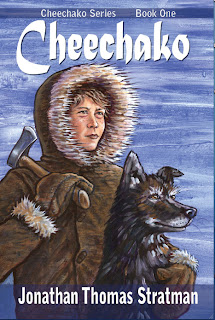
I've just reissued my first novel, "Cheechako," an adventure youth novel, with a brand-new painted cover, and I'm thrilled about it. The only negative criticism I had about the book centered on the cover, a photograph of a boy and a sled dog. It was by far the best choice of thousands of photos I considered. But I don't think anybody liked it.

This is the new cover, by nationally known cover-artist, Jesse Watson. Check him out at www.jessewatson.com. Although he does other kinds of art, I think it's fair to say he specializes in covers, not just the drawing or painting, but the thinking.


Although I knew he lived here in Port Townsend, I contacted his agent in New York, with sort of the vain hope that we might work something out. To my great surprise Jesse emailed me to set up a meeting and we went from there.

I'm not aware that he read the book. He asked. I knew that the cover needed to be the boy in a parka, the dog and maybe a dogsled. The dogsled turned out to be the hard part. Dog sleds are tough images.

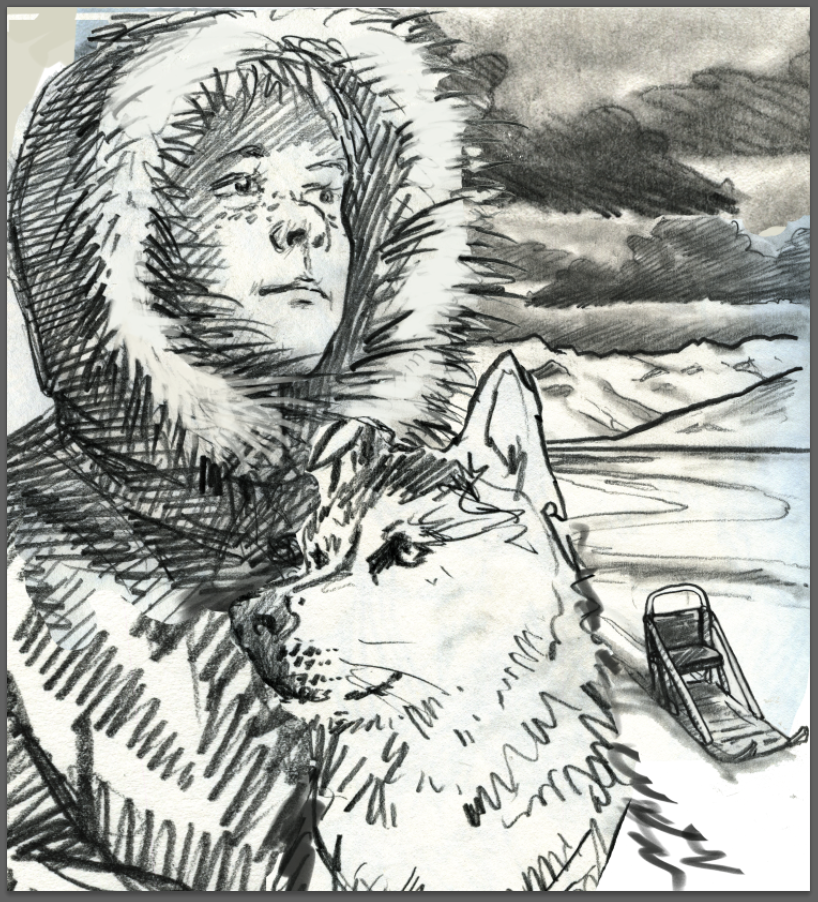
I thought you might like to see the image progression. Here's where he started.


Notice the dog is looking to the side. Here's the other "first draw."


More like this, we thought. "We" being my wife and a small group of relatives and pre-readers, yes, including my 87 year-old-mother who didn't like the photo cover from the start. Yeah, I know, listen to your mother.

So we all liked the second drawing. Except for the boy looking a little young, I would have put this "rough" sketch on the cover. I thought and think that it is fantastic.

We were having real trouble with the sled and somewhere along the line the concept of a stylized blizzard, kind of blue and swirly began to emerge. We also needed the "boy," to look less young and freckly and more ready for adventure.

Although there are several scenes in the book that legitimately involve a hatchet, I was leery of putting a hatchet on the cover because of the very popular Gary Paulsen book of that name. If you haven't read it, you're missing a treat. As you can see, this sketch became the foundation for the final painting.


Now I'm several weeks from publication of the second novel in this "Cheechako" series. I'm delighted to say the next one, "Float Monkeys" will also feature a Jesse Watson cover. More about that soon

Thanks for reading. Write any time with questions or comments.

Jonathan 

Friday, March 29, 2013

ANNOUNCING: Cheechako, the Audio Book.

Don't have time to do your own reading? How about letting me read it to you. Seriously, Cheechako is now out as an audio book, on the Audible site, read by the author. And you'll soon be able to find it on the Amazon site, as well, right next to the Kindle and paperback options.


Cheechako is a great read ... or hear ... for your fifth, sixth or seventh grader, especially for keeping the peace on  family excursions. And don't worry, you'll like hearing it, too. In fact, even though it was written as a "youth" book, most of the readers and known reviewers are adults.


Cheechako Audio Sample

Thanks for reading.

Jonathan


Tuesday, March 12, 2013

Get set for Cheechako on Audible!

Yesterday I finished and uploaded the audio version of Cheechako. That's right, the entire book, unabridged as a sound recording. I understand it takes a week or so for the Audible folks to do their thing and then the sound files should be easily available, along with the Kindle and paperback versions, right on the Amazon site.

Oddly, it was a whole different experience to read aloud, and then to hear it, my own words and my own book. I think it must hit in a different part of the brain than when my eyes process it in. Some scenes, some glimpses proved very emotional for me. Old memories–the Coghill's store scene–played surprisingly real in my mind's eye and well, the truth is, kind of choked me up as I was reading. Suddenly very vivid.

Reading Aloud, A Lost Art?

If you don't have kids or grandkids handy, do you read aloud? I think we get out of the habit. 

Years ago, after I had taken in a foster son, one of his relatives told me that this was the first time in his entire life that he'd had regular showers, a regular bedtime, breakfast, hugs ... and the first time anyone had every read to him consistently. 

Reading aloud is how we can connect with our kids, how we can pass on qualities and experiences we value. How we can pacify ... my mother read to my brothers and me as we did our nightly chore, washing the dishes. She knew if she didn't distract us we would pound on each other. 

She read "The Wind in the Willows," all the Narnia books, the C.S.Lewis adult science fiction ... "Out of the Silent Planet," and others, and I no longer know what all. 

Somehow all three of us survived, all read, and all read to children when we can. 

Test Your Writing by Reading Aloud

Before you put a page to bed, read it aloud. Does it work? Does it flow? Does the sound of it make sense in the way you thought it did when it was just staring at you meekly, dumbly from the page. If you're a very faster reader and skimmer as I am, reading aloud forces you to consider the individual words and your probability of catching typos is also much greater. It's a good way to proof. 

Your Book on Audible

Lastly, it's worth mentioning that recording your book for sale by Audible or another sound recording service so far seems a worthwhile endeavor. If you're not a reader, check out ACX, which has a variety of relatively painless (inexpensive or as a share of profits) ways to get your book voiced, produced, uploaded and for sale. Check it out: www.acx.com

Monday, March 11, 2013

Shaping Creative Ideas From Your Own Past

The one question every writer hears, again and again is "where do you get your ideas?" Although the question is asked seriously, it anticipates an answer like, "a little shop down on such-and-such street. 

Probably not. 

A lot of your best ideas can come from experiences in your own past. To be sure, you probably won't take a whole idea, or a whole piece of your youthful adventure and be able to plot it into something you're working on.

What happens is that you grab "the goodie" from that early experience and bend it to your writer's will. 

Can you do that? Gosh, if not you ... who? 

The Creative Idea That Launched Cheechako

I was about eight years old when I saw my first Tanana River breakup in Alaska. My father was an Episcopal priest and, like the protagonist in Cheechako, we had moved out to Nenana, Alaska from Boston the summer before. 

As I relate in the story, when the siren rang, everybody in Nenana stopped what they were doing, grabbed jackets and headed on the run for the riverbank. "Breakup" in Alaska's interior is a big deal, both because it signifies the end of a really long winter, and because there is a huge (by early Alaska standards) betting pool based on exactly when the ice will go out. The winner goes home with a lot of prize money. 

But it wasn't the breakup as a whole that touched off the CRICKET short story that would be come the genesis for my book. It was something smaller, but very dramatic and very personal. 

The Idea That Launches Your Novel

After all these years, my first few minutes on the riverbank at my first ever breakup are still crystal clear. Someone shouted, "Hey! There's a dog on the ice." By now the ice is a roaring jumble of jagged chunks that have already begun to move, then hung up. For how long? Minutes? Seconds?

So I ran to the dock edge, along with a wave of others, and looked out. Yeah, I saw a dog out there ... mine!

Did I go out on the ice? No. I don't think anyone would, certainly not on purpose. And I didn't feel a bit bad about changing how it happened!  I still remember it all so vividly that, when I sat down searching I couldn't begin my story–and subsequently my novel–anywhere but on that riverbank. 

So if you've been looking for that "launch" idea, chances are good it's already there in your mind and memory, waiting for you to pick it up, blow the dust off and ask yourself ... what if ...?